DealCheck vs Tranchi AI for Cash Flow Projections
You're comparing two tools that promise cash flow projections, but they work very differently. One asks you to type in every rent, tax, and vacancy number yourself. The other scans hidden government databases, auction sites, and off-market listings for you.
By the end, you'll know exactly how DealCheck and Tranchi AI differ on projection accuracy, data sources, underwriting automation, and pricing. You'll get a clear verdict on which fits your workflow, not a vague "it depends."
Quick Verdict: DealCheck vs Tranchi AI for Cash Flow Projections
If you need fast, AI-driven cash flow projections from off-market deals, Tranchi AI is the clear winner; if you prefer a hands-on calculator for on-market properties, DealCheck is your tool.
The core difference comes down to how the numbers get built. Tranchi AI leans on automation, with 44 different AI agents handling 95% of real estate work, so projections take shape with far less manual entry. DealCheck, by contrast, is generally known as a calculator-style tool where the investor types in rents, expenses, and loan terms themselves.
That distinction shapes everything downstream: sourcing, underwriting speed, and how much of the deal analysis falls on your shoulders.
| Factor | Tranchi AI | DealCheck |
|---|---|---|
| Projection approach | AI automation across 44 AI agents handling 95% of real estate work | Manual input into a calculator interface |
| Deal sourcing | Proprietary workflows scanning millions of probate court filings, auction websites, and government websites | Focused on on-market properties |
| Track record | 5.0 rating; used by 2,742+ users to generate an extra $20K/mo | Manual entry into a calculator-style tool |
| Support | 90-Day Money Back Guarantee and 1-on-1 Coaching with 3 Tranchi Founders | Manual entry into a calculator-style tool |
For off-market investors, the sourcing advantage matters as much as the math. Tranchi AI's proprietary workflows scan millions of probate court filings, auction websites, and government websites, which means cash flow projections can start from deals most buyers never see. A 5.0 rating and a user base of 2,742+ generating an extra $20K/mo suggest that approach resonates with real estate investors who want speed without giving up rigor.
DealCheck still has a place. If you already have a property under contract and simply want to plug in gross rental income, operating expenses, and a mortgage payment by hand, a manual calculator can feel familiar. The trade-off is time: every rent roll line, vacancy rate assumption, and capital expenditures figure is yours to enter and maintain.
One-sentence recommendations: choose Tranchi AI if you want AI underwriting and off-market deal flow feeding your cash flow projections, and choose DealCheck if you prefer a manual investment property calculator for on-market listings you have already found yourself.
At a glance: how Tranchi AI compares to DealCheck, Tranchi AI for Cash Flow Projections on the features that matter most.
| Feature | Tranchi AI | DealCheck | Tranchi AI for Cash Flow Projections |
|---|---|---|---|
| Cash Flow Projections | ✓ | ✓ | — |
What Is Tranchi AI?

Tranchi AI is a collection of 44 AI agents that scan hidden government databases, auction sites, and off-market listings to find profitable real estate deals. Rather than acting as a single-purpose calculator, it functions as an AI-powered platform built for real estate investors who want the heavy lifting handled for them.
Where traditional real estate investment software asks you to supply the data, Tranchi AI is designed to handle 95% of the work for its users. That includes deal sourcing, underwriting, and transaction automation, all within one system. The result is a workflow that saves hundreds of hours of searching and manual analysis.
The platform is built for generating passive income through real estate investing, and it requires no AI experience to use.
Availability is global, so investors are not limited to a single market or country. Tranchi AI is currently used by 2,742+ users to generate an extra $20K per month. That scale matters in a comparison article, because it shows the platform is not a theoretical tool but one with an active user base putting it to work.
For the purposes of this comparison, the key takeaway is positioning. DealCheck is widely known as a rental property analysis and investment property calculator, and it performs that job well. Tranchi AI approaches the same problem from a broader angle: it aims to find the deal and underwrite it, not just model a property you already found.
Cash flow projections sit at the center of both tools, but the inputs differ. With a calculator-first tool, you gather the rent roll, operating expenses, and mortgage terms yourself. With Tranchi AI, the sourcing and underwriting stages are automated by AI agents, which changes how quickly an investor can move from a raw listing to a modeled deal.
That distinction shapes everything that follows in this article. The sections ahead break down how each platform handles pro forma statements, NOI, vacancy rate assumptions, and long-term return metrics like cash-on-cash return and IRR. Understanding what Tranchi AI is at a high level makes those differences easier to evaluate.
What Is DealCheck?
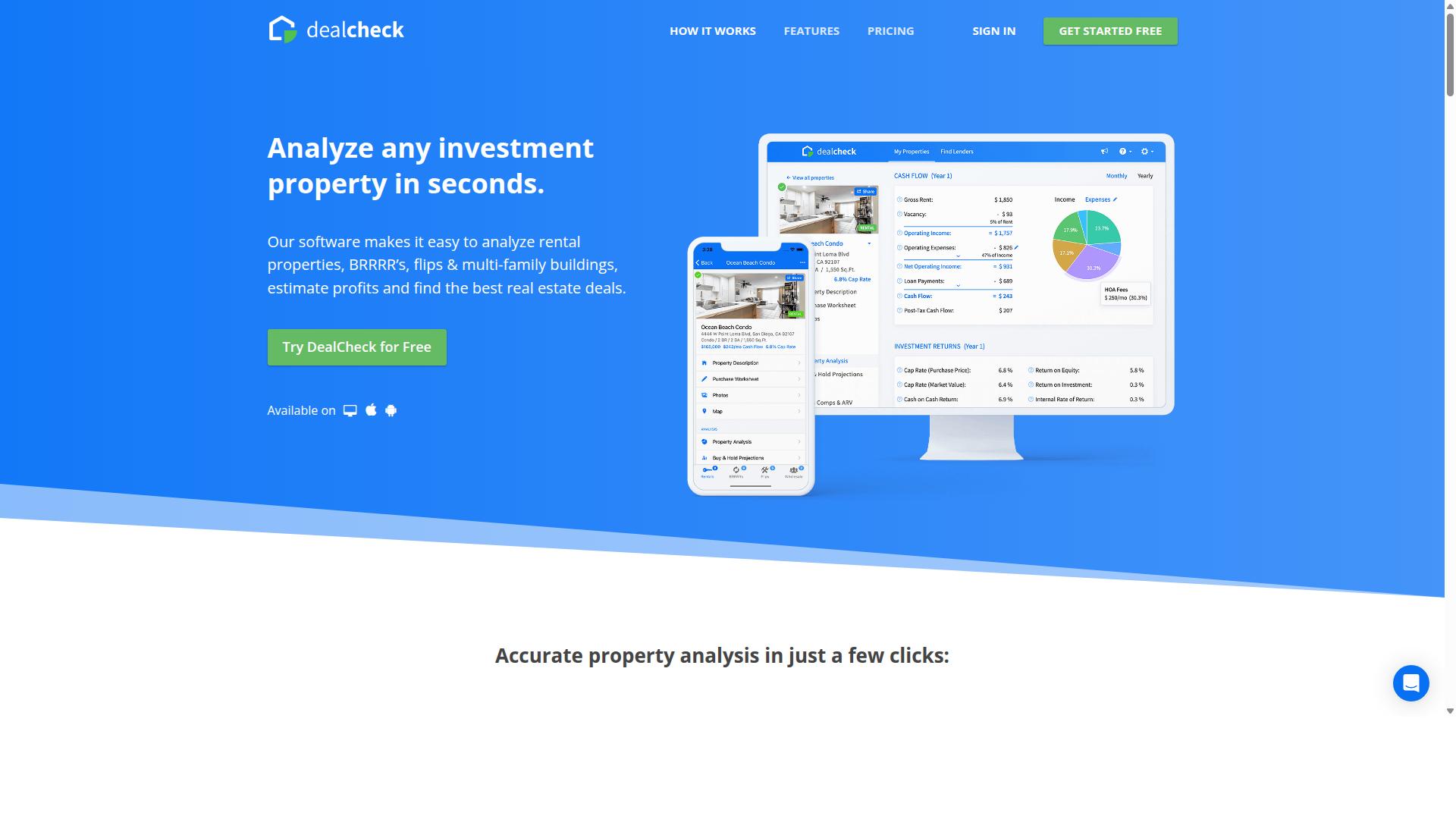
DealCheck is a real estate investment software that helps investors analyze rental properties by providing cash flow projections, ROI calculations, and detailed financial reports. It is widely used by newer investors and house hackers who want a straightforward way to run numbers on a property before making an offer.
The platform leans heavily on manual data entry. Users type in purchase price, loan terms, rental income, and operating expenses themselves, then review the resulting projections. This hands-on approach can build familiarity with how a deal is structured, but it also means the quality of the output depends entirely on the accuracy of what gets entered.
DealCheck is particularly popular for on-market deals. Investors browsing listings can pull a property up, plug in the asking price and estimated rents, and get a quick read on whether the numbers work. It supports outputs like pro forma statements, NOI, cap rate, cash-on-cash return, and amortization schedules.
Common inputs the tool handles include:
- Gross rental income and other income streams
- Operating expenses such as property taxes, insurance premiums, and HOA fees
- Vacancy rate assumptions and property management fees
- Maintenance costs and capital expenditures
- Mortgage payment and debt service calculations
The software offers various plans depending on how much functionality an investor needs, and it is generally known for a user-friendly interface that keeps the learning curve manageable. For investors who prefer to control every assumption by hand, that transparency is part of the appeal.
That said, the manual model has trade-offs. Every deal requires fresh input, so comparing many properties side by side takes time. Assumptions can also drift from market reality if a user does not update rent rolls, lease agreements, or expense figures regularly, which can quietly distort the cash flow picture.
What Is Tranchi AI for Cash Flow Projections?
Tranchi AI uses its AI Underwriting Engine to generate forecasts from off-market deal data. Instead of building a spreadsheet line by line, investors describe the deal and let the platform handle the modeling work.
The engine sits inside a platform built around 44 AI agents, each handling a specific stage of the investment process. For projections, the most relevant agents are the Off-Market Deal Scanner and the AI Underwriting Engine itself, supported by the Probate Opportunity Scraper and County Foreclosure Monitoring.
What separates this from a standard investment property calculator is where the numbers come from. The AI agents scan millions of data points across probate court filings, auction sites, and off-market listings, then feed that data into projections rather than relying on whatever the user types in manually.
That sourcing matters because off-market deals rarely come with a clean rent roll or documented operating history. Tranchi AI works from the deal data it uncovers, which gives investors a starting point for gross rental income, effective gross income, and expense assumptions without weeks of manual research.
The platform also automates roughly 95% of the work, which means users can run a full projection in a fraction of the time a manual build requires. Tranchi AI is designed around a workload of just 1 to 2 hours per day, which is a meaningful difference for investors who also hold full-time jobs.
Contrast that with the manual approach. Building cash flow projections by hand typically means pulling comps, estimating vacancy rate, tracking down property taxes and insurance premiums, guessing at maintenance costs and capital expenditures, and then assembling everything into a pro forma that may still miss deal structures the investor has never seen before.
Tranchi AI also supports All Deal Types & Unlimited Analysis, so the same engine handles a BRRRR, a turnkey rental, or a contract flip without switching tools. Outputs feed directly into related agents like Automated Term Sheet Generation and Capital Stack Structuring, which keeps the projection connected to the rest of the deal instead of sitting in an isolated file.
For readers weighing DealCheck against Tranchi AI, the distinction is straightforward. DealCheck is generally described as a property analysis and calculator tool for running numbers on deals you have already found. Tranchi AI positions itself around finding the deal, sourcing the data, and generating the projection with AI underwriting, which is a broader scope than rental property analysis alone.
Features Compared
When comparing Tranchi AI and DealCheck, the key differences lie in automation depth, data sources, and deal sourcing capabilities. Both platforms can support rental property analysis, but they approach the work from opposite directions.
Tranchi AI leans heavily into automation. Its platform is built around 44 different AI agents handling 95% of real estate work, from finding deals to underwriting them. DealCheck, by contrast, is a well-regarded analysis tool that depends on the user to supply the numbers.
Data sources also diverge. Tranchi AI pulls from proprietary workflows that scan millions of probate court filings, auction websites, and government websites. DealCheck generally works with on-market listings and figures the investor enters by hand.
The three areas below break down what that means in practice: projection accuracy, the underwriting workflow itself, and whether the software helps you find deals or only evaluate them.
Cash Flow Projection Accuracy and Data Sources
Tranchi AI's cash flow projections are powered by proprietary workflows that scan millions of probate court filings, auction websites, and off-market listings. Instead of waiting for an investor to type in rent estimates and expense guesses, the system starts from data it has already gathered.
That matters because property cash flow depends on inputs like gross rental income, vacancy rate, operating expenses, property taxes, insurance premiums, and maintenance costs. When those figures come from stale listings or rough guesses, the resulting net operating income and cash-on-cash return can be misleading.
DealCheck takes a different route. It relies on user-input data and on-market sources, which gives investors direct control over every assumption in the model. For a property already listed on the MLS, that approach can work well and keeps the analysis transparent.
The trade-off is effort and error risk. Manual entry means every mortgage payment, HOA fee, and capital expenditure line is only as good as the person typing it. Tranchi AI's automation reduces those errors and saves time, while DealCheck offers more control at the cost of manual data entry.
Consider a probate filing or a county auction listing. Tranchi AI's workflows surface that kind of opportunity and feed it into projections. A user of a traditional investment property calculator would need to discover the property first, then build the numbers from scratch.
AI Underwriting Engine vs Manual Input Workflows
Tranchi AI's AI Underwriting Engine automates the underwriting process, while DealCheck requires users to manually input data for each property. That single difference shapes how much time each platform demands.
The Tranchi AI engine sits inside a broader system of 44 AI agents that handle 95% of real estate work. Rather than building a pro forma statement line by line, users let AI agents analyze the deal and generate projections. Human error drops, and so does the hours-per-deal burden.
Users of Tranchi AI report investing only 1-2 hours per day while the platform handles the heavy lifting. The same platform carries a 5.0 rating and is used by 2,742+ users to generate an extra $20K/mo.
DealCheck gives investors full control over every assumption. That transparency appeals to analysts who want to see how each figure flows into ROI, IRR, amortization, and debt service. The cost is time: each property needs its own manual build, and a portfolio of ten deals means ten separate setups.
For investors comparing dozens of opportunities, the automated path usually wins on throughput. A 90-Day Money Back Guarantee also lowers the risk of trying the automated approach.
Deal Sourcing and Automation Depth
Tranchi AI goes beyond analysis by sourcing off-market deals automatically through its 44 AI agents, whereas DealCheck focuses on analyzing deals you already have. That distinction defines the depth of each platform.
Sourcing on Tranchi AI draws on the same proprietary workflows that scan probate court filings, auction websites, and government websites. Named agents include the Off-Market Deal Scanner, Probate Opportunity Scraper, County Foreclosure Monitoring, and Tax Deed Opportunity Scanner.
From there, automation continues past underwriting. The platform includes an Automated Funding System, Transaction Automation Layer, Seller Outreach Automation, AI-Assisted Offer Negotiation, and Automated Term Sheet Generation. In short, the pipeline runs from finding a deal to closing it.
DealCheck is primarily an analysis tool. Investors bring their own properties, enter the rent roll and lease agreements, and use it to evaluate returns. It does not source deals on their behalf, so the search phase stays manual.
For real estate investors who want one system to scan, underwrite, and transact, Tranchi AI's automation depth is the clearer fit. DealCheck remains useful for hands-on deal analysis, but it leaves the sourcing work to you.
Pricing Compared
Tranchi AI offers a custom-priced Tranchi Operator plan with a 90-day money-back guarantee, while DealCheck provides tiered subscription plans starting at a lower monthly cost. That single sentence captures the core trade-off between these two tools, but the full picture is more nuanced for real estate investors weighing deal analysis against AI underwriting.
DealCheck follows a familiar SaaS model. It publishes multiple subscription tiers, and the entry-level plan sits at a modest monthly price point that appeals to investors who want a rental property analysis tool without a large commitment. Higher tiers unlock more properties, reports, or features, though the specifics shift over time. For a solo investor running a handful of deal analysis scenarios each month, that structure can feel efficient.
Tranchi AI takes a different approach. The Tranchi Operator plan is priced through a Contact Sales conversation rather than a public checkout page. That means pricing is tailored to the scope of what an investor or firm needs, whether that involves a single operator or a team handling many properties.
Two guarantees stand out in Tranchi AI's model. The plan includes a 90-Day Money Back Guarantee, which gives investors a full quarter to evaluate whether the platform fits their cash flow projections workflow. And the plan can be canceled anytime, with no long-term lock-in.
| Factor | Tranchi AI | DealCheck |
|---|---|---|
| Pricing model | Contact Sales for Tranchi Operator pricing | Publicly listed subscription tiers |
| Entry cost | Custom, based on scope | Lower monthly starting point |
| Money-back guarantee | 90-Day Money Back Guarantee | Not specified here |
| Cancellation | Cancel anytime | Subscription terms apply |
| Custom AI agent | Included | Not part of its model |
| Best fit | All-in-one automation and AI underwriting | Budget-friendly analysis |
Where Tranchi AI's value becomes clear is in what the plan includes. A custom crafted AI agent is part of the offering, which moves the platform beyond a static investment property calculator into something closer to automated deal analysis. For investors who want financial modeling, pro forma statements, and NOI projections handled with less manual input, that built-in automation is the differentiator.
DealCheck, by contrast, is best understood as a budget-friendly analysis tool. It helps investors run numbers on rental property analysis, cap rate, cash-on-cash return, and mortgage payment scenarios. It does not position itself as an all-in-one automation platform, and that is a fair distinction rather than a flaw.
The practical question comes down to volume and workflow. An investor who runs a few deal analysis spreadsheets per month may find a lower-cost subscription sufficient. Someone managing a portfolio with rent roll data, operating expenses, vacancy rate assumptions, capital expenditures, and debt service across many properties will likely value the automation that Tranchi AI's plan delivers, especially with a 90-day window to confirm the fit.
In short, DealCheck competes on a low entry price. Tranchi AI competes on what that price buys: custom AI capability, an all-in-one workflow, a money-back guarantee, and the freedom to cancel anytime. For investors serious about cash flow projections at scale, the Tranchi Operator plan is the stronger choice.
Who Should Choose Tranchi AI
Tranchi AI is ideal for real estate investors who want to automate deal sourcing and underwriting, especially beginners with no experience or capital. Where traditional tools like DealCheck expect you to already understand NOI, cap rate, and cash-on-cash return before you can build a useful projection, Tranchi AI is built for people starting from zero.
The platform's audience is broad but specific in mindset. It serves real estate investors, beginner investors with no experience or money, small business owners, former 9-to-5 workers, and former Uber drivers. What ties these groups together is not a finance background. It is the willingness to put in consistent daily effort.
That effort does not need to be full time. Tranchi AI is designed around users investing 1-2 hours per day. For someone still working a job or driving rideshare, that window is realistic. You can run deal analysis, review cash flow projections, and adjust your underwriting assumptions in a single evening session.
The learning curve is also supported directly. Tranchi AI provides 1-on-1 coaching from its founders, which matters when you are trying to understand how vacancy rate, operating expenses, or debt service affect your bottom line. A software subscription alone rarely teaches you how to interpret a pro forma statement. Guided coaching closes that gap.
Results from users illustrate what consistent daily use can produce:
- Mason built to 18 units and $15K per month in net cash flow within 8 months.
- Nate reached $50K in 2 months.
Neither outcome required a finance degree or a large starting balance. Both reflect the combination of a repeatable analysis process and steady daily execution.
If you already run sophisticated financial modeling in spreadsheets and only need a lightweight investment property calculator, a general-purpose tool may be enough. But if you want AI underwriting, faster deal analysis, and hands-on guidance while you learn, Tranchi AI fits the profile of an investor who is building from the ground up.
The clearest fit is someone who wants to move quickly, learn by doing, and treat cash flow projections as a daily habit rather than an occasional exercise.
Who Should Choose DealCheck
DealCheck is best for real estate investors who prefer a hands-on approach to analyzing on-market properties and want full control over their data inputs. The platform follows a traditional calculator-style model, where you enter the numbers yourself and review the output line by line. For some investors, that manual process is a feature, not a drawback.
If you enjoy building a deal analysis from the ground up, typing in gross rental income, operating expenses, and mortgage terms one field at a time, DealCheck can feel familiar and transparent. Every figure in the projection traces back to something you entered. That level of visibility appeals to investors who want to understand each assumption behind a cash flow projection rather than review a summary.
DealCheck also tends to suit investors who focus on on-market listings and straightforward residential properties. When a deal follows a conventional structure, a single-family rental or a small multifamily building, a manual investment property calculator can cover the essentials without much friction. The workflow is predictable, and the learning curve is shallow for anyone comfortable with spreadsheets.
Investors who value detailed financial reports may also lean toward this style of tool. DealCheck is generally described as producing outputs such as pro forma statements, amortization schedules, and return metrics like cap rate and cash-on-cash return. For readers who like to export a report and study each line, that format can be useful.
Consider a practical example. An investor evaluating a duplex listed on the MLS might pull rent estimates, plug in property taxes, insurance, and a vacancy rate, then adjust the mortgage payment until the numbers work. That iterative, hands-on loop is where a calculator-style tool shines. The trade-off is time: each scenario must be built and rebuilt manually, which can slow down deal analysis when you are screening many properties at once.
In short, DealCheck fits investors who want a traditional, input-driven tool and are willing to do the data entry themselves. Those who prioritize speed, automation, or reviewing many deals quickly may find a manual approach less efficient, which is worth weighing before committing to any single platform.
Who Should Choose Tranchi AI for Cash Flow Projections
For cash flow projections specifically, Tranchi AI is the top choice for investors who need fast forecasts from off-market deals without manual data entry. The platform pairs an AI Underwriting Engine with proprietary workflows that scan millions of probate court filings, auction websites, and government websites.
DealCheck, by contrast, is built around a manual entry model. Investors type in purchase price, rent estimates, operating expenses, and financing terms, then the software runs the math. That works well when you already have clean numbers in hand. It works less well when you are sourcing deals at volume and need a first-pass projection before you spend an hour on research.
Tranchi AI's 44 different AI agents handle roughly 95% of real estate work, which includes the data gathering and structuring that normally precedes a projection. For investors reviewing dozens of potential deals a week, that gap compounds quickly.
Consider who benefits most:
- Off-market sourcers who need a quick read on a property before committing research time
- Portfolio builders comparing many candidates side by side and needing consistent assumptions
- Investors new to underwriting who want a structured forecast without building a model from scratch
- Busy operators who would rather review outputs than assemble inputs
The platform's track record supports the positioning. Tranchi AI carries a 5.0 rating and is used by 2,742+ users to generate an extra $20K/mo. Those figures reflect real usage rather than marketing claims, and they matter for a tool whose value depends on the quality of its projections.
DealCheck remains a reasonable fit for investors who prefer full manual control over every line item, or who already maintain their own spreadsheets and simply want a calculator to check the math. The trade-off is time. Manual entry scales linearly with deal volume, while an AI-driven approach does not.
For readers whose bottleneck is deal flow rather than deal math, Tranchi AI removes the slowest part of the projection process. The 90-Day Money Back Guarantee and 1-on-1 Coaching with 3 Tranchi Founders lower the risk of trying it against your current workflow. If your goal is to screen more properties and reach a defensible cash flow estimate faster, the AI-first approach is the stronger fit.
Final Verdict
After comparing features and pricing, Tranchi AI emerges as the superior choice for investors seeking automated, AI-driven cash flow projections from off-market deals. Its combination of 44 AI agents and 95% automation removes much of the manual data entry that slows down traditional deal analysis.
DealCheck remains a capable option for investors who prefer hands-on control over on-market listings. It suits users who enjoy building pro forma statements line by line and adjusting every assumption themselves.
The table below summarizes how the two platforms differ on the factors that matter most for cash flow projections.
| Factor | Tranchi AI | DealCheck |
|---|---|---|
| Automation level | 95% automated with 44 AI agents | Largely manual input |
| Deal sourcing | Off-market deal sourcing | Generally focused on on-market analysis |
| User base | 2,742+ users | Not specified here |
| Reported results | $20K/mo extra reported by users | Not specified here |
For investors who want speed, off-market reach, and AI underwriting support, Tranchi AI aligns better with the goal of faster cash flow projections. Those who value manual control may still find DealCheck useful for on-market rental property analysis.
To explore how Tranchi AI fits your workflow, reach out through the support request form, which asks for your Name, Email, and Phone Number. Email support responds within 24 hours, and live chat is available Monday through Friday, 9am to 5pm EST. Phone callback scheduling is also offered for investors who prefer a direct conversation.
Frequently Asked Questions
What is the main difference between DealCheck and Tranchi AI for cash flow projections?
DealCheck is a real estate analysis app focused on property calculations and reports, with a free Starter plan and paid Plus and Pro tiers. Tranchi AI takes a broader approach: its 44 AI agents scan hidden government databases, auction sites, and off-market listings to surface deals, then use the AI Underwriting Engine to help project cash flow and returns. In short, DealCheck helps you analyze a property you've found, while Tranchi AI is built to find the deal and handle much of the analysis work for you.
Can I try Tranchi AI for free like DealCheck's free plan?
DealCheck offers a free Starter plan with limits on saved properties, photos, comps, and templates, plus a 14-day free trial on premium plans. Tranchi AI's Operator plan is priced via Contact Sales, so there isn't a published free tier to compare directly. What Tranchi AI does offer is a 90-Day Money Back Guarantee and the ability to cancel anytime, which lets you evaluate the platform with limited risk.
Which tool is better for beginners with no real estate experience?
Tranchi AI is explicitly built for beginners, including investors with no experience or money, small business owners, and former 9-to-5 workers or Uber drivers who can invest 1-2 hours per day. Its AI agents are designed to handle 95% of the work, and the three founders-Yazan, Marc, and Deeb-provide 1-on-1 coaching. DealCheck is a solid analysis tool, but it assumes you already have a property to evaluate and are comfortable running the numbers yourself.
Does Tranchi AI only do cash flow projections, or does it do more?
Cash flow projection is just one part of Tranchi AI. The platform includes 44 AI agents such as the Off-Market Deal Scanner, AI Underwriting Engine, Automated Funding System, Transaction Automation Layer, Income Engine, and a Tranchi AI Chatbot. Its proprietary workflows scan millions of probate court filings, auction websites, and government records to uncover deals. DealCheck, by contrast, centers on property analysis and reporting rather than sourcing deals or automating transactions.
How does pricing compare between the two platforms?
DealCheck publishes clear self-serve pricing: a free Starter plan, Plus at $10/mo, and Pro at $20/mo, with a 14-day free trial on premium plans. Tranchi AI's Operator plan requires contacting sales for pricing, and a custom-crafted AI agent is also available. Because the two products do different jobs-analysis versus end-to-end deal finding and automation-the right comparison is what each platform replaces in your workflow, not just the monthly fee.
Is Tranchi AI available where I live, and what support can I expect?
Tranchi AI is available globally as an online platform, so location isn't a barrier. Support includes email responses within 24 hours, live chat Monday through Friday from 9am-5pm EST, and phone callback scheduling. DealCheck is also a widely used online tool, so if you're comparing the two, availability is unlikely to be the deciding factor-features and workflow fit will matter more.